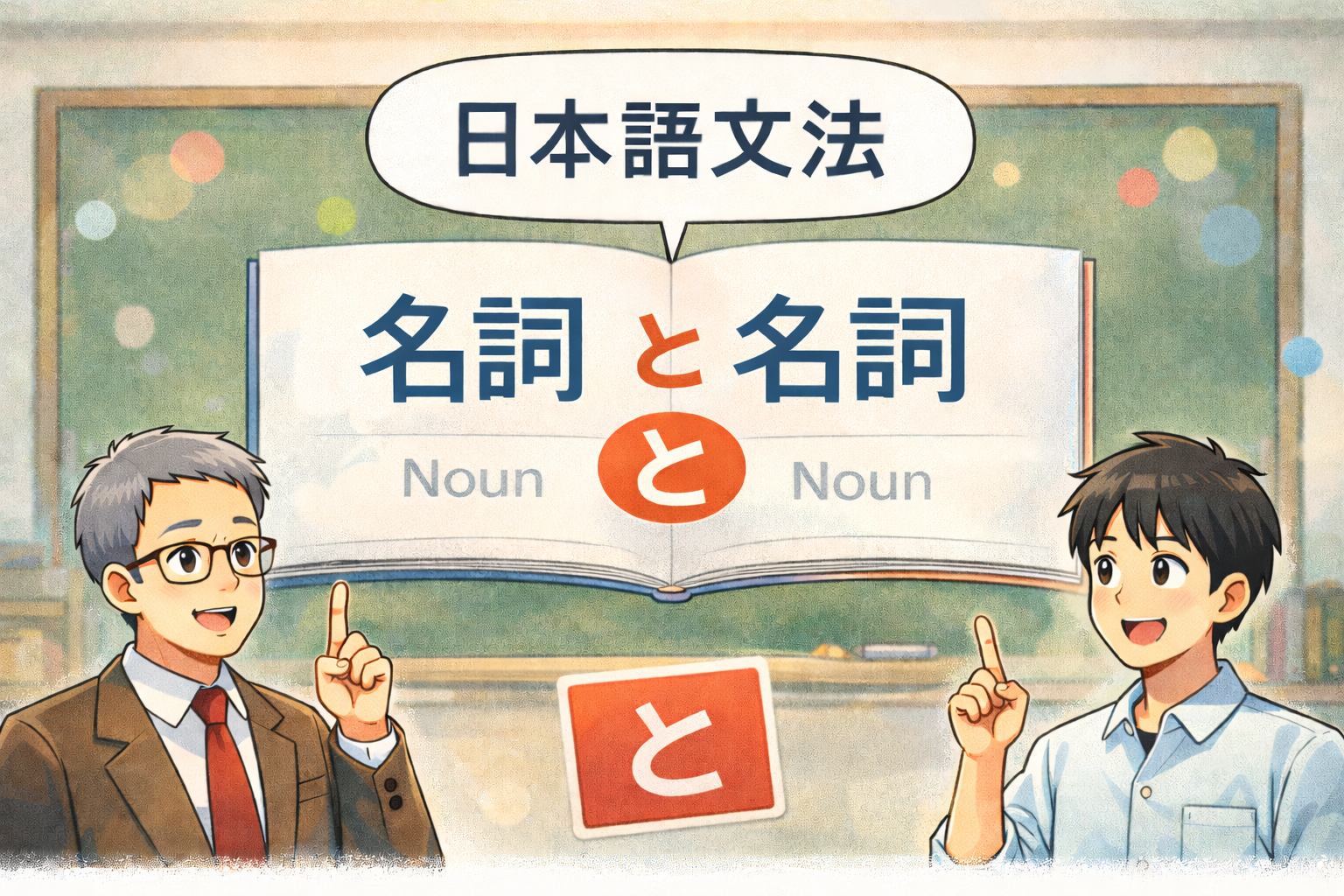

NとN
What Does “と” Mean?
Hello everyone! How’s your Japanese study going?
Let’s learn a new piece of Japanese grammar together today!
Today’s grammar point is “Noun + と + Noun.”
In Japanese, と is a particle used to connect nouns. You use it when there are two or more nouns that are the target of a verb or adjective, and you want to mention all of them (basically, the full list).
For example, imagine John and Adam are in a room, and you want to tell someone that both of them are there. In Japanese, you would say:
部屋にJohnとAdamがいます。
You can also use と to connect more than two nouns.
If Smith is also in the room with John and Adam, the sentence becomes:
部屋にJohnとAdamとSmithがいます.
One important thing to remember is this:
You need to insert と between the nouns, but once the list of nouns is finished, you must use the correct particle for the verb or adjective that follows.
That’s why you cannot say something like:
❌ 部屋にJohnとAdamと Smithといます.
The と is only for connecting nouns — after that, the sentence continues with the proper particle and verb.

Examples You Use Every Day
お客:すみません。リンゴとバナナがありますか。
店員:ええ。今日はくだものが安いですよ。たくさん買ってくださいね!
Customer: Excuse me. Do you have apples and bananas?
Shop clerk: Yes, we do. Fruit is cheap today, so please buy a lot!

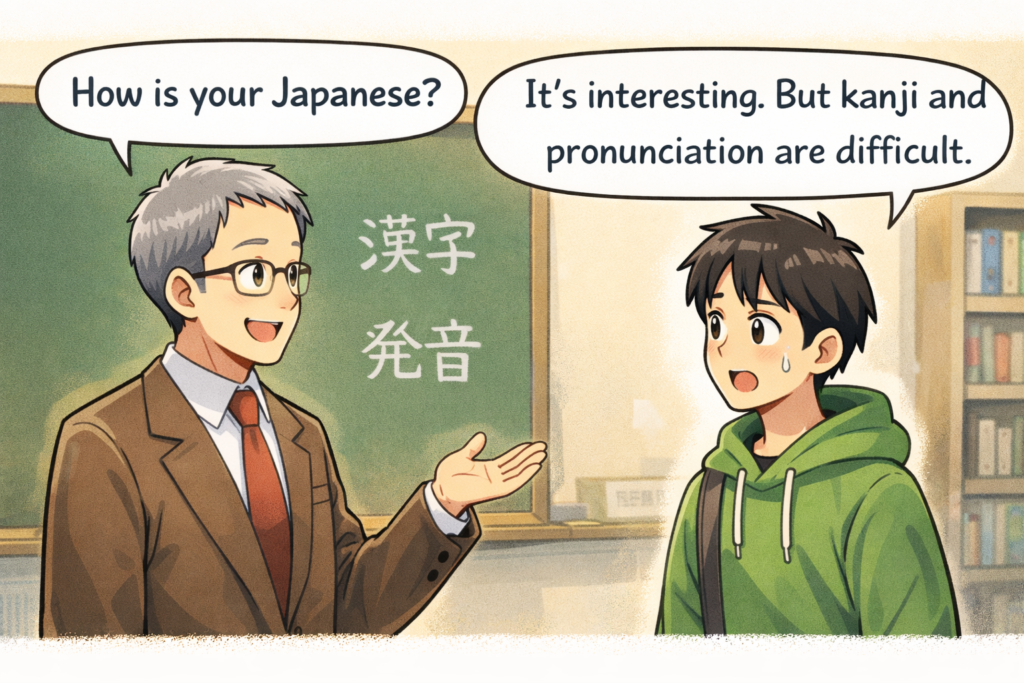
先生:日本語はどうですか。
学生:おもしろいです。でも漢字と発音がむずかしいです。
Teacher: How is your Japanese?
Student: It’s interesting. But kanji and pronunciation are difficult.
You Did It! Now You Can Use “と” with Confidence
Great job today! Did you understand “Noun + と + Noun” well?
Today’s grammar might not feel very difficult, but to use it well, you need to learn more nouns. After all, when you use this grammar, you always have to say two or more nouns.
The more words you learn, the more things you’ll be able to say in Japanese.
So keep up the good work, and let’s keep learning more and more Japanese together!! 💪🇯🇵✨
For Japanese Teachers
Today, we introduced the Japanese grammar pattern “Noun + と + Noun.”
Although it was not covered in this article, this structure is often easily confused with “Noun + や + Noun.” It is important for instructors to explain the differences between these grammar points in a clear and accessible way.
In addition, the particle と has many different uses, such as in patterns like “Person + と + Verb.” When teaching this grammar, it is helpful to keep these other usages in mind and to clearly distinguish them so that learners do not become confused.